AI Aggregator vs Individual AI Tools: Which Saves You More Money in 2026?
You've got a decision to make, and it's one that's going to cost you real money either way. On one hand, you could keep doing what you're doing — paying for ChatGPT Plus, Claude Pro, Midjourney, and a handful of other AI tools individually, each with its own billing cycle, its own login, and its own price hike every few months. On the other hand, you could switch to an AI aggregator — one platform, one subscription, access to multiple models and tools. Sounds cheaper. Sounds simpler. But is it actually better for your wallet, or are you just trading one set of problems for another? I'm not going to tell you aggregators are automatically the right answer. That would be dishonest. The truth is that the math depends entirely on how you use AI, which tools you rely on, and what features you actually need. This article breaks down the real costs, the hidden trade-offs, and the specific scenarios where each option wins. No affiliate bias. No vague "it depends" hand-waving. Just clear numbers and honest comparisons so you can make the call yourself. Let's Define the Two Options Clearly Before we compare costs, let's make sure we're talking about the same things. Individual AI tools means you subscribe directly to each AI service you use. You pay OpenAI for ChatGPT, Anthropic for Claude, Midjourney for image generation, and so on. Each subscription is separate. Each bill is separate. You manage everything yourself. An AI aggregator means you pay …
You’ve got a decision to make, and it’s one that’s going to cost you real money either way.
On one hand, you could keep doing what you’re doing — paying for ChatGPT Plus, Claude Pro, Midjourney, and a handful of other AI tools individually, each with its own billing cycle, its own login, and its own price hike every few months.
On the other hand, you could switch to an AI aggregator — one platform, one subscription, access to multiple models and tools. Sounds cheaper. Sounds simpler. But is it actually better for your wallet, or are you just trading one set of problems for another?
I’m not going to tell you aggregators are automatically the right answer. That would be dishonest. The truth is that the math depends entirely on how you use AI, which tools you rely on, and what features you actually need.
This article breaks down the real costs, the hidden trade-offs, and the specific scenarios where each option wins. No affiliate bias. No vague “it depends” hand-waving. Just clear numbers and honest comparisons so you can make the call yourself.
Let’s Define the Two Options Clearly
Before we compare costs, let’s make sure we’re talking about the same things.
Individual AI tools means you subscribe directly to each AI service you use. You pay OpenAI for ChatGPT, Anthropic for Claude, Midjourney for image generation, and so on. Each subscription is separate. Each bill is separate. You manage everything yourself.
An AI aggregator means you pay one platform that bundles access to multiple AI models or tools. Instead of five subscriptions, you have one. The aggregator handles the backend connections to the AI providers, and you interact with everything through a single interface.
Examples of aggregators in 2026 include Poe (consumer chat), OpenRouter (developer API), TypingMind (bring-your-own-keys frontend), and enterprise suites like AWS Bedrock. We covered the full breakdown of aggregator types in our What Is an AI Aggregator? guide if you need a refresher.
Now let’s get to the numbers.
The Real Cost Comparison: Individual vs. Aggregator
Scenario 1: The Casual User (2–3 AI Tools)
This is someone who uses AI a few times a week — mostly for writing help, occasional research, and maybe some image generation.
Expense
Individual Subscriptions
Aggregator (Poe)
ChatGPT Plus
$20/month
Included
Claude Pro
$20/month
Included
Midjourney Basic
$10/month
Not included
Monthly Total
$50/month
~$20/month + $10 for Midjourney = $30/month
Annual Total
$600/year
~$360/year
Savings
—
~$240/year
The aggregator saves you money here, but the savings are modest. You’re still paying separately for Midjourney because most chat aggregators don’t include specialized image generation tools. Your real savings come from consolidating ChatGPT and Claude into one Poe subscription at $19.99/month.
Scenario 2: The Power User (5–7 AI Tools)
This is a content creator, marketer, or solopreneur who uses AI daily across multiple tasks — writing, coding, research, image generation, and voice.
Expense
Individual Subscriptions
Aggregator (Poe + Standalone)
ChatGPT Plus
$20/month
Included in Poe
Claude Pro
$20/month
Included in Poe
Perplexity Pro
$20/month
Included in Poe
Cursor Pro
$20/month
Not included (standalone needed)
Midjourney Standard
$30/month
Not included (standalone needed)
ElevenLabs Starter
~$5–$22/month
Not included (standalone needed)
Poe Subscription
—
$19.99/month
Monthly Total
~$115–$132/month
~$75–$92/month
Annual Total
~$1,380–$1,584/year
~$900–$1,104/year
Savings
—
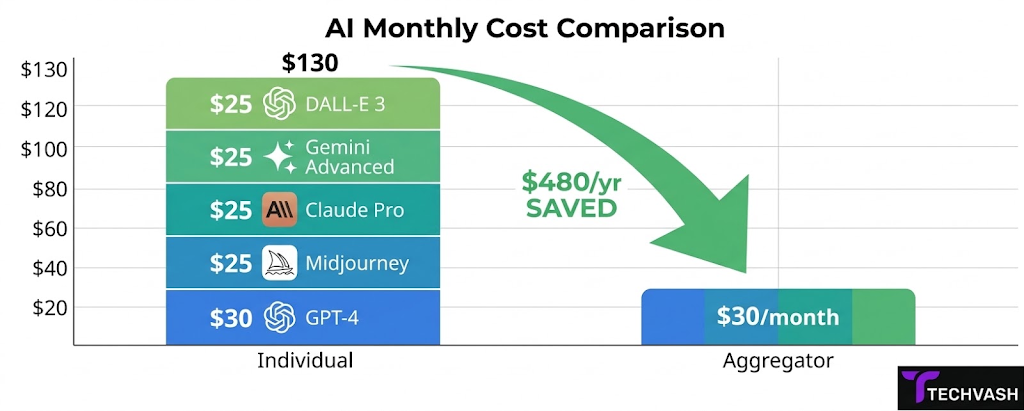
~$480/year
Verdict: The savings become meaningful at this level — roughly $40/month or $480/year. But notice the pattern: the aggregator covers your text-based AI models well (ChatGPT, Claude, Perplexity), but you still need separate subscriptions for specialized tools like Cursor, Midjourney, and ElevenLabs. The aggregator doesn’t eliminate all your subscriptions. It reduces them.
Scenario 3: The Developer (API-Based Usage)
This is someone building AI-powered features into a product and paying per API call rather than flat monthly subscriptions.
Expense
Individual API Access
Aggregator (OpenRouter)
OpenAI API (GPT-4o)
Pay per token directly
Pass-through rate (same cost)
Anthropic API (Claude)
Pay per token directly
Pass-through rate (same cost)
Google API (Gemini)
Pay per token directly
Pass-through rate (same cost)
Platform fees
None
~5–5.5% on credit purchases
Integration dev time
3 separate integrations
1 integration
Monthly Cost
Varies by usage
Varies by usage + small platform fee
Verdict: For developers, the aggregator doesn’t necessarily save money on raw API costs — OpenRouter charges pass-through rates with no markup on inference, meaning you pay the same per-token price as going direct. The small credit purchase fee (~5–5.5%) actually makes it slightly more expensive on a pure cost-per-token basis. The real savings for developers is in engineering time. One integration instead of three means fewer hours spent writing and maintaining separate API connections. At a developer rate of $75–$150/hour, saving 10–20 hours of integration work pays for the platform fee many times over.
Scenario 4: The Enterprise Team (10+ Seats)
Expense
Individual Subscriptions
Enterprise Aggregator (AWS Bedrock)
10× ChatGPT Team
~$250/month
Included
10× Claude Team
~$250/month
Included
10× Copilot
~$300/month
Included
Admin & compliance overhead
High (manual)
Built-in
Monthly Total
~$800+/month
Negotiated, typically $300–$600/month
Annual Savings
—
$2,400–$6,000+/year
Verdict: This is where aggregators deliver the biggest financial impact. Enterprise suites like AWS Bedrock, Microsoft Copilot Studio, and Google Vertex AI bundle multiple models under volume pricing that individual subscriptions can’t match. The compliance and governance features (SSO, audit logs, data residency controls) also eliminate hidden costs associated with managing shadow AI usage across your organization.
The Hidden Costs Nobody Talks About
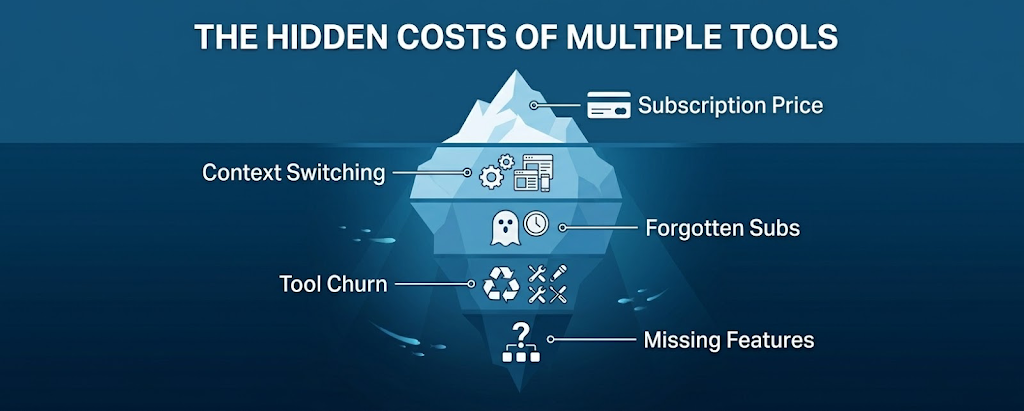
Raw subscription prices only tell part of the story. Here are the costs that don’t show up on your credit card statement but absolutely affect your bottom line.
The Cost of Context Switching
Every time you switch between ChatGPT, Claude, and Perplexity, you lose focus. You re-enter your project context. You re-upload your files. You adjust your prompting style to match each tool’s quirks.
The American Psychological Association estimates that task switching can reduce productive efficiency by up to 40%. If you’re a solopreneur billing your time at $50/hour and you lose even 30 minutes a day to tool switching, that’s roughly $250/month in lost productivity — more than the cost of most aggregator subscriptions.
An aggregator eliminates most of this switching by putting multiple models in one interface. You stay in one tab. Your context stays intact.
The Cost of Forgotten Subscriptions
Be honest: how many AI tools are you currently paying for that you haven’t used in the last 30 days?
Subscription creep is one of the biggest silent drains on small business budgets. You signed up for a free trial in January, forgot to cancel, and now you’ve been paying $20/month for seven months for a tool you used twice. Aggregators consolidate your billing into one line item, making it much harder for zombie subscriptions to hide.
The Cost of AI Tool Churn
Hundreds of AI startups have shut down or been acquired over the past couple of years. When a tool you’ve built your workflow around disappears, you spend hours — sometimes days — finding a replacement, migrating your data, and retraining yourself or your team.
Aggregators absorb this churn for you. If one underlying model or tool goes away, the platform typically replaces it with an equivalent. Your workflow keeps running without interruption.
The Cost of Missing Native Features
Here’s where individual tools have the advantage. When you subscribe directly to ChatGPT, you get access to every feature OpenAI releases — Canvas editing, Advanced Data Analysis, custom GPTs, memory, and more. When you access GPT-4o through an aggregator like Poe, you get the core text generation capability, but many of those advanced native features aren’t available.
If your workflow depends heavily on specific native features, the “savings” from an aggregator might actually cost you more in lost functionality. You’d need to evaluate this on a tool-by-tool basis.
When Individual AI Tools Are Actually the Better Choice
I promised honesty, so here it is: there are clear situations where keeping your individual subscriptions makes more financial and practical sense.
You Only Use One or Two AI Tools
If your entire AI workflow revolves around ChatGPT and nothing else, paying $20/month directly to OpenAI is simpler and cheaper than paying $20/month to an aggregator that gives you access to models you’ll never use. Aggregators save money through consolidation. If there’s nothing to consolidate, there’s nothing to save.
You Rely Heavily on Native Features
If you use ChatGPT’s Canvas for long-form editing, Claude’s Projects for organizing research, or Midjourney’s style reference system for consistent brand imagery, an aggregator will likely feel like a downgrade. You’ll end up paying for the aggregator AND keeping your most-used individual subscription, which means you’re spending more, not less.
You Need Maximum Usage Volume
Aggregators typically impose usage limits, even on paid plans. Poe’s points system, for example, gives you a generous monthly allocation, but heavy users can burn through their points on GPT-4o and Claude 4 well before the month ends. If you’re generating thousands of messages per month, a direct subscription with higher or unlimited usage caps may be more cost-effective.
You Work in a Regulated Industry
If you handle HIPAA-protected health data, attorney-client privileged communications, or financial records subject to SEC regulations, routing your prompts through a third-party aggregator adds a compliance layer you may not want to manage. Direct subscriptions with business associate agreements (BAAs) from the AI provider are often the safer — and legally required — choice.
When an AI Aggregator Is Clearly the Better Choice
You Use Three or More Text-Based AI Models Regularly
This is the sweet spot. If you’re paying for ChatGPT, Claude, and Perplexity separately ($60/month), switching to Poe at $19.99/month gives you all three plus additional models for roughly a third of the cost. The math is straightforward and the savings are immediate.
You’re a Developer Managing Multiple API Integrations
Even though OpenRouter’s per-token costs are roughly equivalent to going direct, the engineering time savings from maintaining one integration instead of five is substantial. Fewer integrations also mean fewer points of failure and less debugging when an API changes.
You Run a Team That Needs Centralized AI Access
Managing 15 separate AI subscriptions across a 10-person team is an administrative nightmare. An enterprise aggregator gives you one contract, one billing relationship, centralized usage tracking, and built-in governance. The per-seat cost is almost always lower than buying individual subscriptions at scale.
You Want to Experiment Without Committing
If you’re still figuring out which AI models work best for your specific use case, an aggregator lets you test GPT-4o, Claude 4, Gemini 2.5, Llama 4, and Mistral side by side without subscribing to each one individually. This experimentation phase is where aggregators deliver the most value — you can make an informed decision about which tools deserve their own subscription later.
The Hybrid Approach: What Most Smart Users Actually Do in 2026
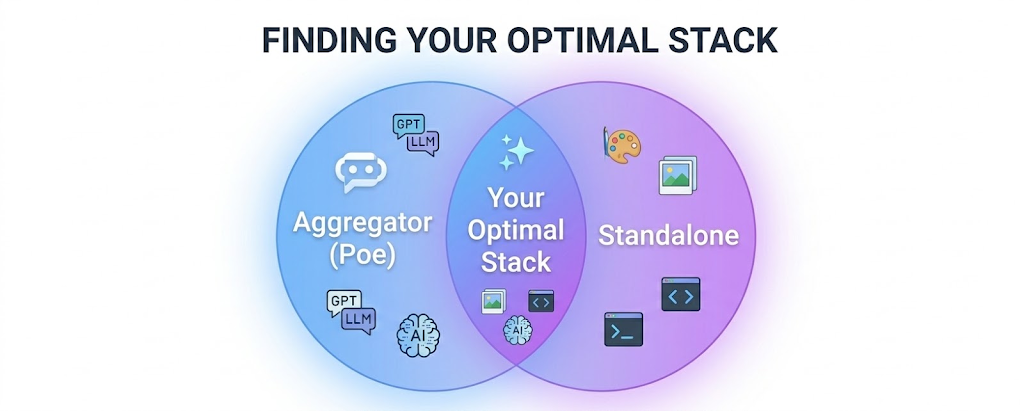
Here’s the reality that most “aggregator vs. individual” articles won’t tell you: the best setup for most people isn’t one or the other. It’s both.
The most cost-effective approach in 2026 looks like this:
Use an aggregator for your general-purpose AI needs.
Poe ($19.99/month) or TypingMind ($39–$99 one-time) covers your daily text generation, research, brainstorming, and model comparison. This replaces 3–5 individual text AI subscriptions.
Keep individual subscriptions for your specialized tools.
Midjourney for image generation. Cursor for coding. ElevenLabs for voice. These tools have proprietary features that aggregators can’t replicate, and their standalone costs are justified by the unique value they deliver.
Result: You go from 7–8 subscriptions at $125–$150/month down to 3–4 subscriptions at $50–$70/month. That’s a 50–60% reduction in your AI tool spend without sacrificing any functionality.
This hybrid approach is what most power users and small businesses have settled on in 2026. It gives you the cost savings of aggregation where it makes sense and the full feature depth of individual tools where it matters.
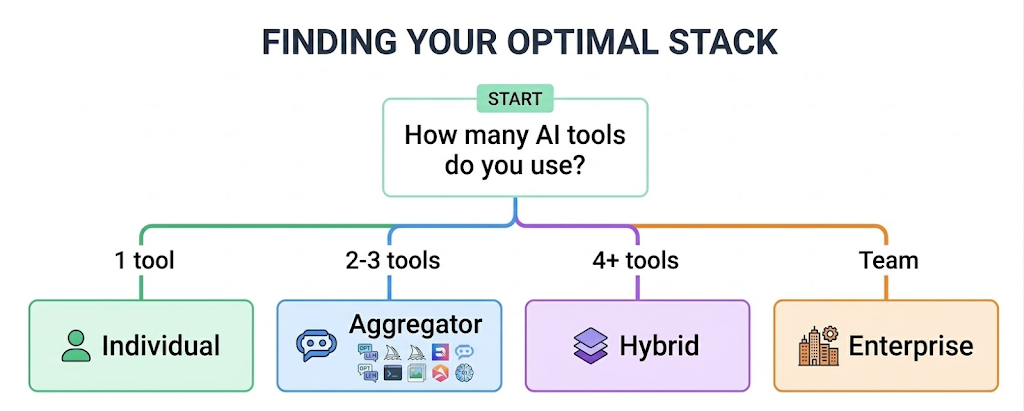
Quick Decision Framework
Use this to make your call in under 60 seconds:
If you…
Choose…
Use only 1 AI tool
Individual subscription
Use 2–3 text AI models
Aggregator (Poe or TypingMind)
Use 4+ AI tools including specialized ones
Hybrid (aggregator + 1–2 standalone)
Build AI features into software
API aggregator (OpenRouter)
Manage AI for a team of 10+
Enterprise aggregator (AWS Bedrock, Copilot)
Work in healthcare, legal, or finance
Individual subscriptions with BAAs
Want to experiment with new models
Aggregator (test before you commit)
Frequently Asked Questions
Is an AI aggregator always cheaper than individual AI tools?
No. If you only use one or two AI tools, individual subscriptions are usually cheaper and simpler. Aggregators save money when you’re consolidating three or more subscriptions into one. The savings come from eliminating redundant billing, not from getting individual tools at a discount.
How much can I realistically save by switching to an AI aggregator?
For a typical power user with 5–7 AI subscriptions totaling $115–$130/month, switching to a hybrid setup (one aggregator plus 1–2 specialized standalone tools) can reduce costs to roughly $50–$70/month — a savings of $480–$720 per year. Enterprise teams can save significantly more through volume pricing.
Will I lose features if I switch to an aggregator?
You may lose access to some advanced native features. Aggregators typically provide core model capabilities (text generation, basic reasoning, code completion) but don’t replicate specialized features like ChatGPT’s Canvas, Claude’s Projects, or Midjourney’s style references. Evaluate which native features you actually use before switching.
Can I try an aggregator without canceling my current subscriptions?
Yes. Most aggregators offer free tiers or low-cost entry plans. Sign up for Poe’s free tier or buy TypingMind’s $39 Standard license, test the experience alongside your existing subscriptions for a few weeks, and only cancel individual tools once you’re confident the aggregator covers your needs.
Are there hidden costs with AI aggregators?
The main hidden costs are usage limits (points systems, rate caps), the potential need to keep specialized standalone subscriptions, and the extra data routing through a third-party server. Read the aggregator’s pricing page and privacy policy carefully before committing.
Which aggregator gives the best value for money in 2026?
For most individual users, Poe at $19.99/month offers the best value for multi-model chat access. For developers, OpenRouter provides the most flexible pay-as-you-go API access with 500+ models. For enterprises, AWS Bedrock delivers the best combination of model variety, compliance, and volume pricing.
The Bottom Line
The question isn’t “aggregator or individual tools?” The question is “how many AI tools am I actually paying for, and how many of them could be consolidated?”
If the answer is three or more text-based AI models, an aggregator will almost certainly save you money. If you’re a heavy user of specialized tools with unique native features, keep those individual subscriptions and aggregate the rest. And if you only use one AI tool, don’t overcomplicate it — just pay for that one tool directly.
The hybrid approach — aggregator for general use, individual subscriptions for specialized needs — is the smartest financial strategy for most AI users in 2026. It cuts your costs roughly in half without sacrificing the features you actually depend on.