Key takeaways
- An AI aggregator gives access to AI models or AI tools from one place.
- 2 main types exist: model aggregators and AI tools directories.
- Model aggregators buy API access from AI labs and resell it in credits, points or messages.
- 5 documented limits exist: opaque metering, delayed models, missing vendor features, third-party prompt handling and reseller risk.
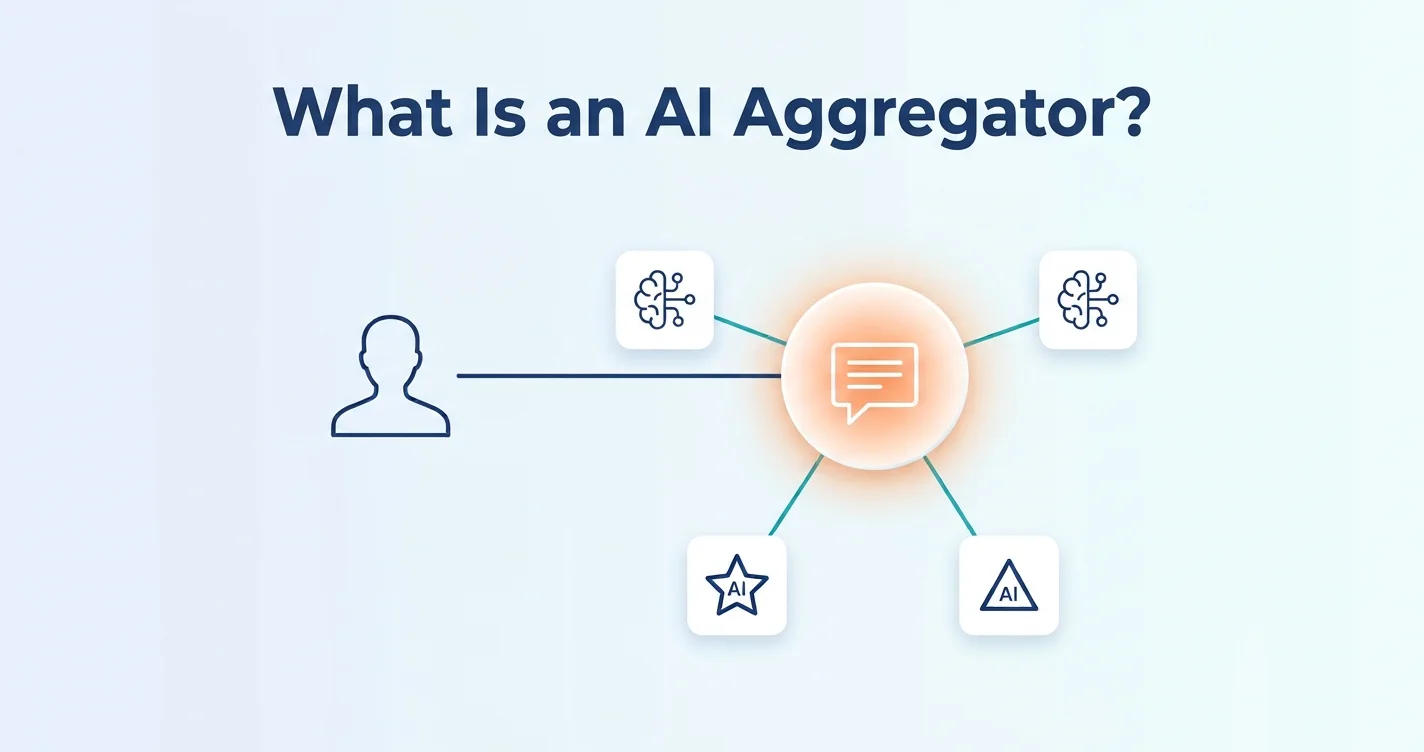
An AI aggregator is a platform that gives access to AI models or AI tools from one place, so users work through one account instead of separate vendor sites. The term has 3 meanings: model aggregators, AI tools directories and AI news aggregators. This article covers the first 2.
What are the types of AI aggregators?
AI aggregators fall into 2 main types: model aggregators and AI tools directories. A third meaning, AI news aggregators, is excluded here. The table compares all 3.
| Type | What it gathers | How users access it | Examples |
|---|---|---|---|
| Model aggregator | AI models from different labs, such as GPT, Claude and Gemini | One account, billed in credits, points or messages | Poe, OpenRouter, Abacus ChatLLM |
| AI tools directory | Listings of AI tools, grouped by function, with pricing data | Browsing and filtering a catalog, then visiting each tool | There’s An AI For That, Futurepedia, Toolify.ai |
| AI news aggregator (excluded) | AI-related news articles | Reading a feed | Not covered here |
A model aggregator runs the models for the user. A directory lists tools and sends the user to each one. Krater, an AI platform, describes a model aggregator as one account that fronts models from labs such as OpenAI, Anthropic and Google.
How does an AI aggregator work?
A model aggregator works as a middle layer between the user and AI labs. The process has 5 steps.
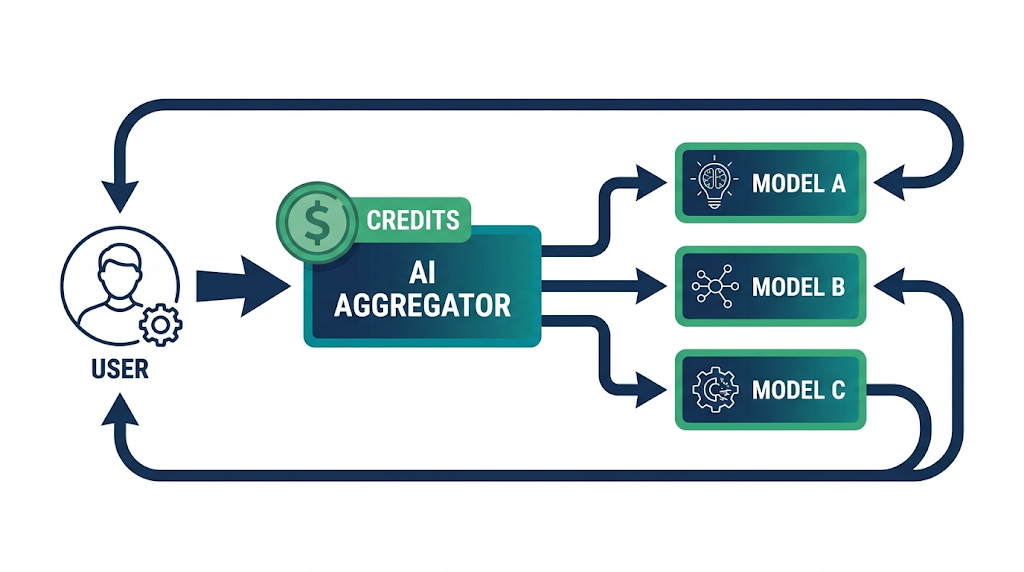
- The user types a prompt in the aggregator’s interface and selects a model.
- The aggregator sends the prompt to the lab’s model through an API.
- The model runs inference on the prompt and returns the output as tokens.
- The aggregator displays the output to the user.
- The aggregator deducts usage from the user’s credits, points or message allowance.
According to Krater, labs price API use per million tokens, and aggregators resell those tokens inside one interface with one bill. Aggregators either call the labs directly or route through an infrastructure layer such as OpenRouter. The output matches the lab’s own app because the underlying model is the same.
What features does a model aggregator offer?
A model aggregator offers 5 core features. The list names each feature with its source.
- Model access: One interface reaches models from different labs.
- Unified billing: One bill covers every model used.
- Model comparison: Poe compares models such as Claude 3 Opus and GPT-4 inside one conversation, according to CDOTrends (April 2024).
- Routing and fallback: OpenRouter switches to another provider of the same model during an outage or rate limit, according to DeployHQ.
- Spend controls: OpenRouter provisions per-developer API keys with daily, weekly or monthly spend limits, according to DeployHQ.
How do AI aggregators price their services?
AI aggregators use 4 pricing models. The table lists each model with an example and adds a lab subscription for comparison.
| Pricing model | How it bills | Example |
|---|---|---|
| Credits | Credits per action, with cost varying by model and task | Krater |
| Points | Points per message, with cost varying by model | Poe |
| Pay-as-you-go plus platform fee | Provider rates plus a 5.5% fee on pay-as-you-go usage | OpenRouter |
| Own API key | One-time interface license, with the provider billing tokens | TypingMind |
| Lab subscription (comparison) | Fixed monthly fee with native app features | The lab’s own app |
The platform fee figure comes from DeployHQ, and Codecademy describes it as around 5%. Prices change, so verify each figure on the platform’s pricing page before quoting it.
Krater states a rule of thumb: flat subscriptions reward volume, and meters reward variety. A user who runs one model heavily can pay less with a flat subscription. A user who tests 3 or more models can pay less with a meter.
How do AI aggregators make money?
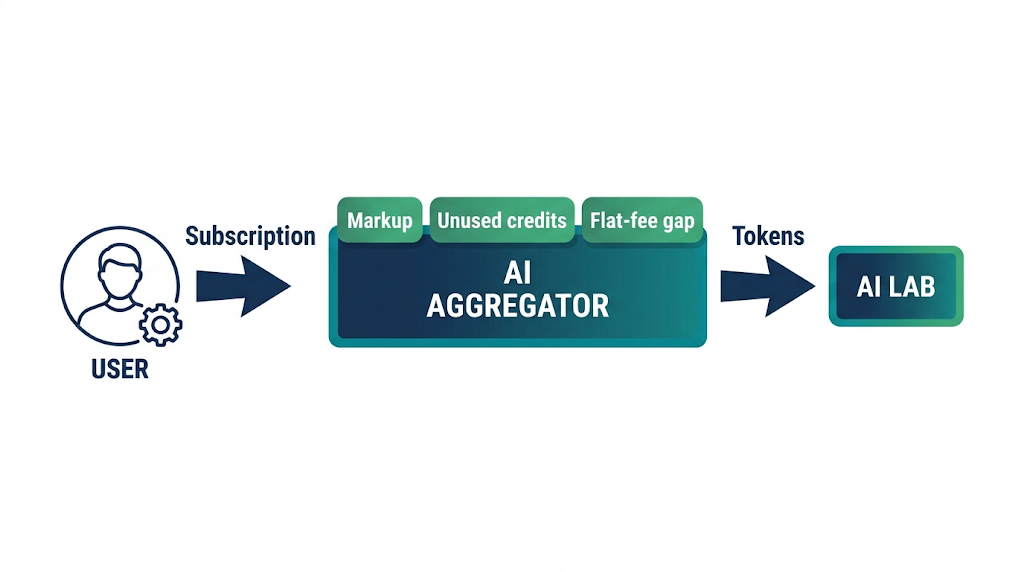
AI aggregators earn margin from 3 sources, according to Krater.
- Token markup: The aggregator buys tokens at published per-million rates and resells them at a higher price inside a subscription.
- Breakage: Expired or unused credits and allowances become revenue.
- Flat-fee gap: The difference between a flat fee and actual consumption becomes margin.
OpenRouter states a different model. DeployHQ reports that OpenRouter bills providers’ published rates without markup and charges a platform fee instead.
Flat vector diagram, 16:9, white background. A user icon pays a box labeled “AI aggregator” with an arrow labeled “Subscription”. The box pays a box labeled “AI lab” with an arrow labeled “Tokens”. Three small tags on the aggregator box: “Markup”, “Unused credits”, “Flat-fee gap”. Dark blue and green palette, no other text.
Flat vector diagram, 16:9, white background. A user icon pays a box labeled “AI aggregator” with an arrow labeled “Subscription”. The box pays a box labeled “AI lab” with an arrow labeled “Tokens”. Three small tags on the aggregator box: “Markup”, “Unused credits”, “Flat-fee gap”. Dark blue and green palette, no other text.
What are examples of AI aggregators?
Examples include 4 model aggregators and 3 AI tools directories. The table lists the verified attributes of each.
| Platform | Type | Verified attribute |
|---|---|---|
| Poe | Model aggregator | Belongs to Quora; offers chatbots such as GPT-4, Gemini and Claude (CDOTrends, 2024) |
| OpenRouter | Model aggregator and API layer | 400+ models from 60+ providers through one OpenAI-compatible endpoint (DeployHQ) |
| Abacus ChatLLM | Model aggregator | 100+ models, plus image and video generation, app building and agents (Krater) |
| TypingMind | Interface for own API keys | One-time license; providers bill the usage (Krater) |
| There’s An AI For That, Futurepedia, Toolify.ai | AI tools directories | Catalogs that filter tools by pricing, category and rating (Fast.io) |
Directory names come from a Fast.io list of AI tool directories.
How is an AI aggregator different from an AI gateway and an AI tools directory?
An AI aggregator serves end users, an AI gateway serves engineering teams, and an AI tools directory serves shoppers. The table compares the 3 on 4 attributes.
| Attribute | AI aggregator | AI gateway | AI tools directory |
|---|---|---|---|
| Main user | Individuals and small teams | Teams running AI in production | People comparing tools |
| Main job | One interface for many models | Routing, failover, caching and cost control | Catalog and filter AI tools |
| Runs models | Yes, through lab APIs | Passes requests to providers | No |
| Typical billing | Credits, points or messages | Provider usage plus gateway costs | Not applicable |
Maxim describes an AI gateway as a single control point between applications and LLM providers. It handles routing, retries, failover, caching, cost tracking and policy enforcement. OpenRouter sits between the two categories, because it serves developers through an API and routes requests across providers.
What are the benefits of an AI aggregator?
An AI aggregator offers 4 main benefits.
- Consolidates accounts: One login replaces separate lab accounts.
- Simplifies billing: One bill covers models from different labs.
- Enables comparison: Users test one prompt on 2 or more models side by side.
- Reduces cost for light use: Light users can pay less than for multiple separate subscriptions, according to Krater.
What are the limits of an AI aggregator?
An AI aggregator has 5 documented limits, according to Krater.
- Opaque metering: Usage meters can be hard to audit, and heavy use can cost more than a flat subscription.
- Delayed models: New flagship models can arrive days or weeks after the lab’s own app.
- Missing features: Native features such as Projects, Canvas, memory and app integrations are not available through the API.
- Third-party handling: Prompts pass through a third party, so the platform’s logging policy matters.
- Reseller risk: Users depend on the aggregator keeping its API access and staying in business.
Krater sells an aggregator, so its limits list comes from a vendor with a commercial interest in the topic. Check each limit against the platform’s own documentation.
When is a single AI lab’s app better than an aggregator?
A lab’s own app is better in 3 cases, according to Krater.
- The work depends on native features such as Projects, Canvas, memory or Deep Research.
- Compliance requires a contract with the lab itself.
- One model is used heavily enough that a flat subscription costs less than a meter.
How do you choose an AI aggregator?
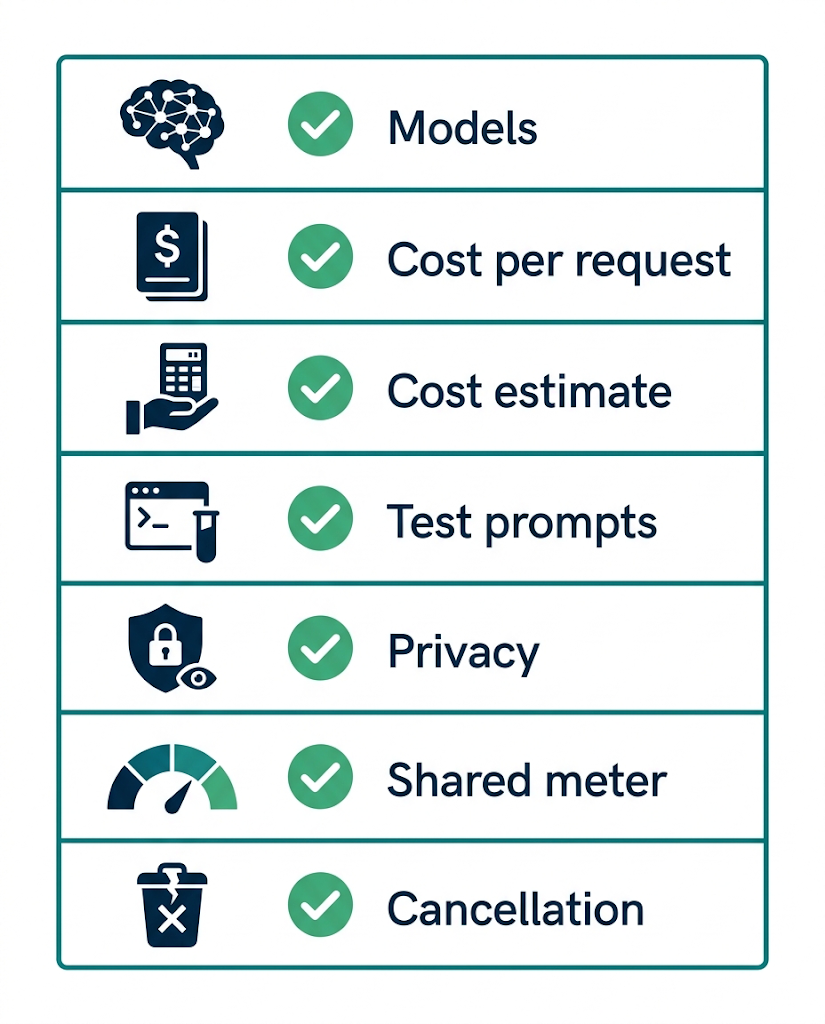
Choosing an AI aggregator takes 7 checks, adapted from Krater’s 10-minute evaluation. The checks follow the user’s workflow, which How to Choose the Right AI Tool for Your Workflow covers in more detail.
- Confirm that the specific model versions the workflow uses are in the model list.
- Identify the metering unit and the cost of one typical request.
- Look for a cost estimate shown before sending.
- Run the 3 most common prompts on the free tier and compare them with the lab’s own app.
- Read the privacy policy for prompt logging and training defaults.
- Check whether image, video and file uploads share the same meter.
- Confirm the cancellation terms and whether unused credits expire.
Frequently asked questions
Do AI aggregators train on user prompts?
The answer depends on the aggregator’s policy and the lab’s API terms, according to Krater. API access generally does not train lab models, but the aggregator can log prompts. OpenRouter does not log prompts by default, according to DeployHQ.
Do AI labs allow aggregators?
Labs sell API access openly and earn token revenue from aggregators, according to Krater. Missing native app features is a product limit, not a policy restriction.
Which AI aggregator is best?
The best choice depends on the use case, according to Krater. Krater names Abacus ChatLLM for entry price, Aymo for teams, Poe for its bot ecosystem and TypingMind for own API keys. Krater also lists itself, so test each platform before choosing.
Sources
- AI Aggregators Explained: What They Are, the Catch, and the Best Ones in 2026, Krater
- OpenRouter: A Team’s Practical Guide to Multi-Model AI Routing (2026), DeployHQ
- What is OpenRouter? A Guide with Practical Examples, Codecademy
- Poe Unveils Multi-bot Chat Feature, CDOTrends, April 2024
- Best AI Tool Directories in 2026, Fast.io
- What Is an AI Gateway? A Complete Guide to Concepts and Capabilities, Maxim