Key takeaways
- AI tools fall into 10 functional types, from assistants and writing to coding, automation and data analysis.
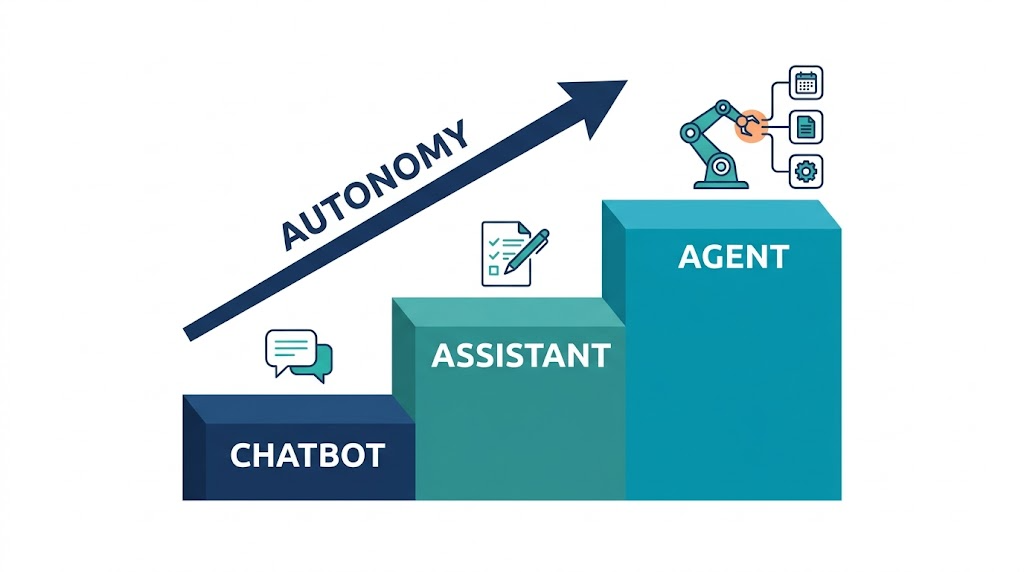
- 3 autonomy levels exist: chatbots, assistants and agents.
- 8 technology types power the tools: NLP, machine learning platforms, computer vision, voice recognition, AI analytics, RPA with AI, generative AI and predictive AI.
- Every AI tool in use today is narrow AI, because artificial general intelligence is not yet developed.
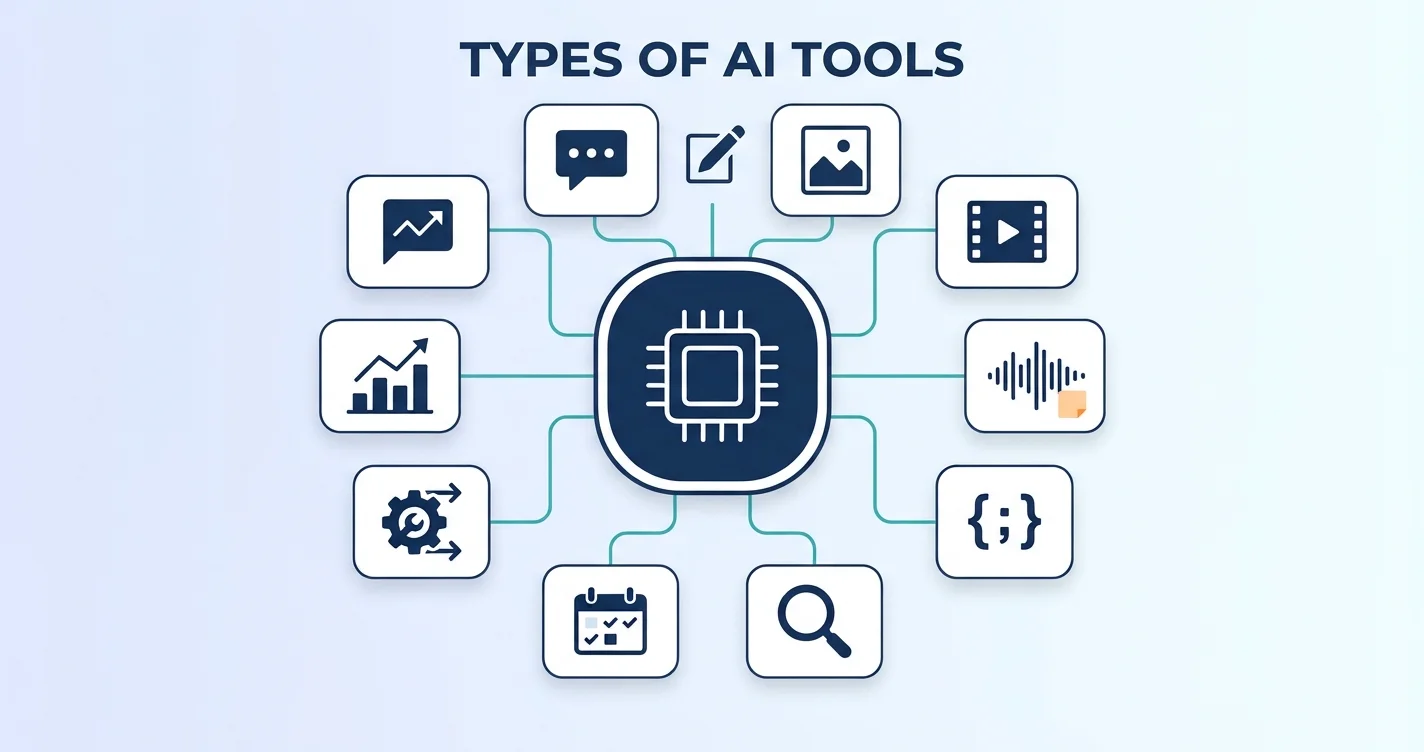
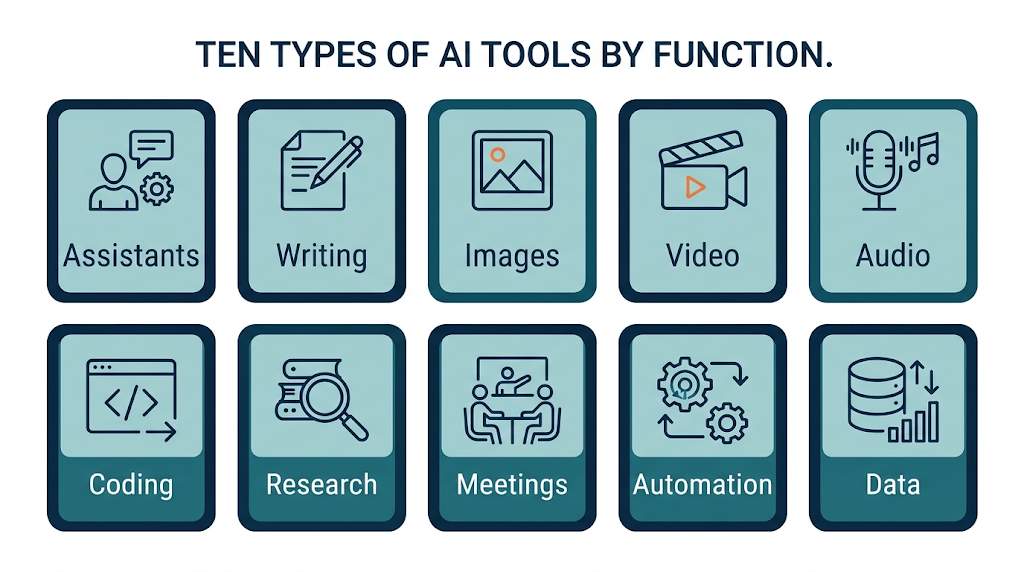
AI tools fall into 10 types by function: assistants, writing, image and design, video, audio and voice, coding, research, meetings and productivity, workflow automation, and data analysis. Each type does one kind of work, such as answering questions, generating images or analyzing data.
What are AI tools?
An AI tool is a program or application that uses artificial intelligence technologies to perform tasks that normally require human intelligence, according to Azeus. The tasks include writing text, recognizing speech, generating images and analyzing data.
The number of AI tools depends on the counting method. Fast.io’s 2026 list reports about 14,200 active AI tools. Its broader count of about 47,000 includes beta, inactive and niche products found in directories.
What are the 10 types of AI tools by function?
AI tools fall into 10 types by function. The table lists each type with its job and example tools.
| # | Type | What it does | Example tools |
|---|---|---|---|
| 1 | General-purpose AI assistants | Answer questions and handle writing, analysis, coding and brainstorming | ChatGPT, Claude, Gemini, Microsoft Copilot |
| 2 | AI writing tools | Draft, rewrite and correct text | Grammarly, Jasper, Notion AI |
| 3 | AI image and design tools | Generate images, vectors and layouts | Midjourney, Adobe Firefly, Recraft, Ideogram, Canva AI |
| 4 | AI video tools | Generate and edit video | Runway, Synthesia, Google Veo, Pika |
| 5 | AI audio and voice tools | Generate speech and music, and recognize speech | ElevenLabs, Suno, Siri, Alexa |
| 6 | AI coding tools | Complete, explain, test and edit code | Cursor, GitHub Copilot, Claude Code |
| 7 | AI research and knowledge tools | Search the web, find papers and answer from uploaded sources | Perplexity, Elicit, NotebookLM |
| 8 | AI meeting and productivity tools | Transcribe, summarize and organize meetings and notes | Otter.ai, Granola, Notion AI |
| 9 | AI workflow automation tools | Connect apps and automate multi-step tasks | Zapier, Make, n8n, UiPath |
| 10 | AI data analysis tools | Analyze datasets and produce predictions | IBM Watson, DataRobot, DataLab |
The tool descriptions in the sections below come from Simplilearn, DataCamp, Fast.io and Azeus.
What do general-purpose AI assistants do?
General-purpose AI assistants answer questions and handle a broad range of tasks in one conversation, such as writing, analysis, brainstorming and coding. Simplilearn lists 4 examples:
- ChatGPT: handles writing, analysis, brainstorming, coding and image generation in one conversation.
- Claude: works with long documents, drafting, source analysis and complex coding problems.
- Gemini: connects with Gmail, Docs, Sheets and Drive as a multimodal assistant.
- Microsoft Copilot: adds AI assistance to Word, Excel, PowerPoint, Outlook and Teams, depending on the license.
Platforms that give access to 2 or more assistants through one account are covered in What Is an AI Aggregator?.
What do AI writing tools do?
AI writing tools draft, rewrite and correct text, and match tone and style to a purpose. DataCamp and Simplilearn describe 3 examples:
- Grammarly: corrects grammar and spelling, and suggests tone and clarity edits.
- Jasper: produces marketing content that matches a brand’s voice.
- Notion AI: drafts, summarizes, translates and edits content inside Notion.
What do AI image and design tools do?
AI image and design tools generate images, vectors, layouts and diagrams from text prompts. Simplilearn and DataCamp describe 6 examples:
- Midjourney: generates images from prompts and, since 2025, animates images into short clips.
- Adobe Firefly: provides generative fill, background replacement and text effects inside Adobe products.
- Recraft: creates vectors, icons, illustrations and mockups in a consistent visual style.
- Ideogram: generates images that contain readable text.
- Canva AI: generates draft designs, presentations and writing inside Canva.
- Napkin.ai: converts text into diagrams, flowcharts and infographics.
What do AI video tools do?
AI video tools generate or edit video from text, images or scripts. Simplilearn describes 4 examples:
- Runway: generates and edits video from text, images or existing footage.
- Synthesia: turns scripts into presenter-led videos with AI avatars and generated voices.
- Google Veo: generates video clips from text or image prompts, including sound.
- Pika: creates short creative videos and social clips.
What do AI audio and voice tools do?
AI audio and voice tools generate speech and music, and convert speech into text or commands. The generation tools and the recognition tools do different jobs.
Generation tools:
- ElevenLabs: generates speech, voiceovers, dubbing and sound effects, according to Simplilearn. DataCamp adds voice cloning in multiple languages.
- Suno: generates complete songs with vocals and instrumentals from text prompts, lyrics or uploaded audio.
Voice recognition tools convert speech to text or let users give voice commands, according to Azeus. Examples include Google Assistant, Amazon Alexa and Apple’s Siri.
What do AI coding tools do?
AI coding tools suggest, explain, test and edit code inside developer environments. Simplilearn and DataCamp describe 3 examples:
- GitHub Copilot: suggests code, explains functions, generates tests and reviews changes in developer tools.
- Cursor: works as an AI-built code editor on VS Code that locates files, refactors and edits across a codebase from natural-language instructions.
- Claude Code: works as an agentic coding tool that edits multiple files and runs commands such as tests.
What do AI research and knowledge tools do?
AI research and knowledge tools find information and answer questions from the web, academic papers or uploaded documents. Fast.io and Simplilearn describe 3 examples:
- Perplexity: gives conversational answers from web search, with links to sources.
- Elicit: finds, extracts and compares academic research papers for literature reviews.
- NotebookLM (also called Gemini Notebook): answers questions using only uploaded documents and creates audio overviews.
What do AI meeting and productivity tools do?
AI meeting and productivity tools transcribe meetings, summarize them and organize notes. DataCamp describes 2 meeting tools:
- Otter.ai: provides real-time transcription, speaker labels and meeting summaries.
- Granola: combines the user’s notes with a meeting audio transcript in a Mac-only notepad, without a meeting bot.
Notion AI also belongs here. It searches workspace knowledge and summarizes meetings inside Notion, according to Simplilearn.
What do AI workflow automation tools do?
AI workflow automation tools connect apps and run multi-step tasks without manual work. Fast.io lists 3 platforms:
- Zapier: connects apps and builds automated workflows.
- Make: connects apps and builds automated workflows.
- n8n: connects apps and builds AI agents, and is available for self-hosting, according to DataCamp and Fast.io.
Robotic process automation (RPA) tools with AI belong to this type. They automate repetitive business processes and handle unstructured data and dynamic decisions, according to Azeus. UiPath is the example Azeus cites.
What do AI data analysis tools do?
AI data analysis tools automate the analysis of large datasets to produce predictions and business intelligence, according to Azeus. The examples:
- IBM Watson: analyzes data for predictions and business intelligence.
- DataRobot: automates analysis and prediction on large datasets.
- DataLab: works as an AI-assisted notebook for Python and R analysis, according to DataCamp.
What are the differences between AI chatbots, AI assistants and AI agents?
AI tools differ by autonomy. A chatbot answers single queries, an assistant helps complete tasks step by step, and an agent plans and acts toward a goal across tools.
| Attribute | Chatbot | AI assistant | AI agent |
|---|---|---|---|
| Definition | Reactive conversational interface that answers from a predefined knowledge base | Prompt-driven tool that helps complete tasks step by step | Goal-driven system that plans, decides and acts across tools and data sources |
| Autonomy | None; waits for a prompt | Low; needs continuous human input | High; works toward a goal and pauses for human approval |
| Task complexity | Simple, single-turn queries | Single tasks, one step at a time | Multi-step, multi-system workflows, including exceptions |
| Memory | Resets each session | No persistent memory described | Keeps state across tasks and time |
| Example | Answering “What is your refund policy?” | Drafting one renewal email | Processing a refund end to end |
What are the types of AI tools by technology?
AI tools fall into 8 types by technology, and one tool often uses more than one. The table lists each technology with its job and an example, according to Azeus and Upwork.
| Technology | What it does | Example |
|---|---|---|
| Natural language processing (NLP) | Analyzes text, detects sentiment, translates and powers conversational AI | Google Translate, Grammarly |
| Machine learning platforms | Provide the infrastructure to build, train and deploy custom ML models | Custom model development |
| Computer vision | Interprets images and video, including image recognition, facial detection, object tracking and OCR | Medical imaging analysis |
| Voice recognition | Converts speech to text or voice commands | Siri, Alexa, Google Assistant |
| AI analytics | Automates analysis of large datasets for predictions and business intelligence | IBM Watson, DataRobot |
| RPA with AI | Automates repetitive business processes with unstructured data | UiPath |
| Generative AI | Creates new text, images, code and other content from training data | ChatGPT, Midjourney |
| Predictive AI | Forecasts trends or behavior from historical data | Credit risk assessment |
Machine learning and deep learning describe how these systems learn. Upwork defines machine learning as learning patterns from data and improving over time, with fraud detection as an example. Deep learning is a subset of machine learning that uses multi-layered neural networks.
Are AI tools narrow AI or general AI?
Every AI tool in use today is narrow AI. Narrow AI performs one dedicated purpose and can match or exceed human ability in that area, according to TechTarget. Artificial general intelligence (AGI) is a theoretical system that could apply to any task, and it is not yet developed.
Upwork also classifies AI by capability. The table lists 5 levels.
| Capability level | Status | Example |
|---|---|---|
| Reactive machines | Exists | IBM’s Deep Blue chess computer |
| Limited memory AI | Exists | Self-driving cars |
| Theory of mind AI | Theoretical | None fully achieved |
| Artificial general intelligence | Theoretical | None yet |
| Self-aware AI | Theoretical | None |
What are open-source AI tools?
Open-source options exist for images and text. Simplilearn names 4 examples: Stable Diffusion and FLUX for images, and Llama and Mistral as open-weight language models.
How do you choose a type of AI tool?
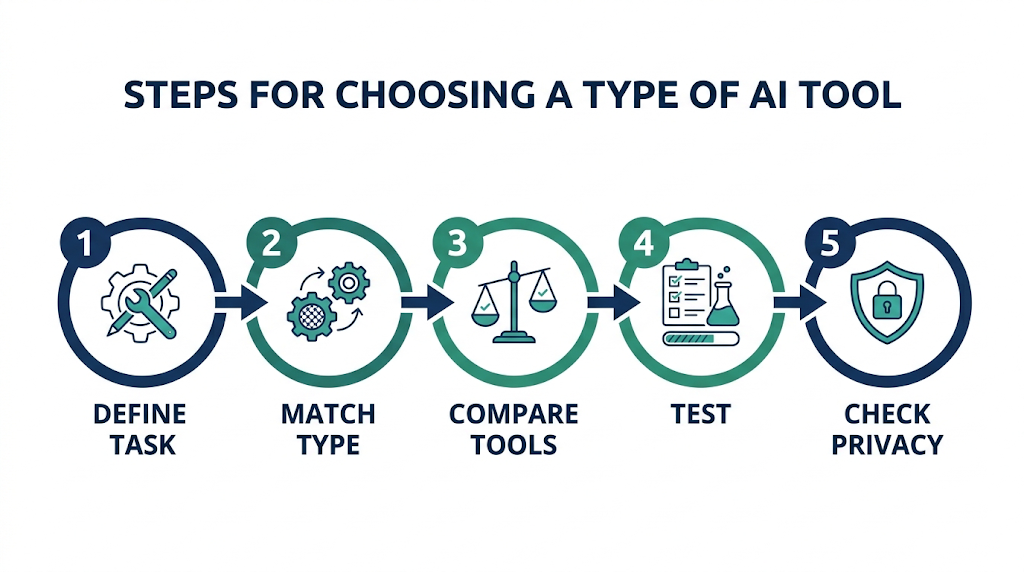
Choosing a type takes 5 steps.
- Write the task in one sentence, such as “summarize weekly meetings”.
- Match the task to one of the 10 types in the table.
- Compare 2-3 tools of that type on input and output formats, price and integrations.
- Test each tool on 3 real tasks and record the time spent and the errors found.
- Read each tool’s privacy policy for prompt logging and training defaults.
The workflow-based version of this process is covered in How to Choose the Right AI Tool for Your Workflow.
Frequently asked questions
How many AI tools exist?
Fast.io reports about 14,200 active AI tools in 2026. A broader count of about 47,000 includes beta, inactive and niche products found in directories.
Where can I find all AI tools in one place?
AI tools directories list tools grouped by function, with pricing data. Examples include There’s An AI For That, Futurepedia and Toolify.ai, according to Fast.io. Model aggregators give access to AI models through one account instead.
Is generative AI the same as an AI tool?
Generative AI is 1 of the 8 technology types behind AI tools. It creates new content, while predictive AI forecasts outcomes from historical data, according to Upwork.