What Is an AI Aggregator? The Smartest Way to Access 100+ AI Tools in One Place (2026)
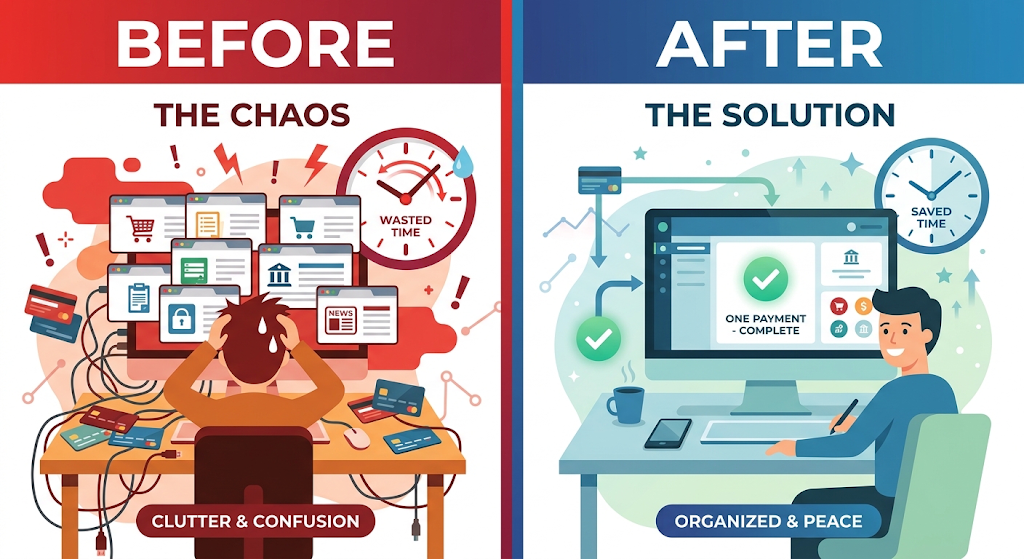
You're probably paying for multiple AI tools, ChatGPT, Claude, Midjourney, Perplexity, and others—while constantly switching between tabs and subscriptions. The problem isn't a lack of AI tools. It's fragmentation. An AI aggregator solves this by bringing multiple AI models and tools into one platform, letting you write, research, create images, code, and more without juggling …
You’re probably paying for multiple AI tools, ChatGPT, Claude, Midjourney, Perplexity, and others—while constantly switching between tabs and subscriptions.
The problem isn’t a lack of AI tools. It’s fragmentation.
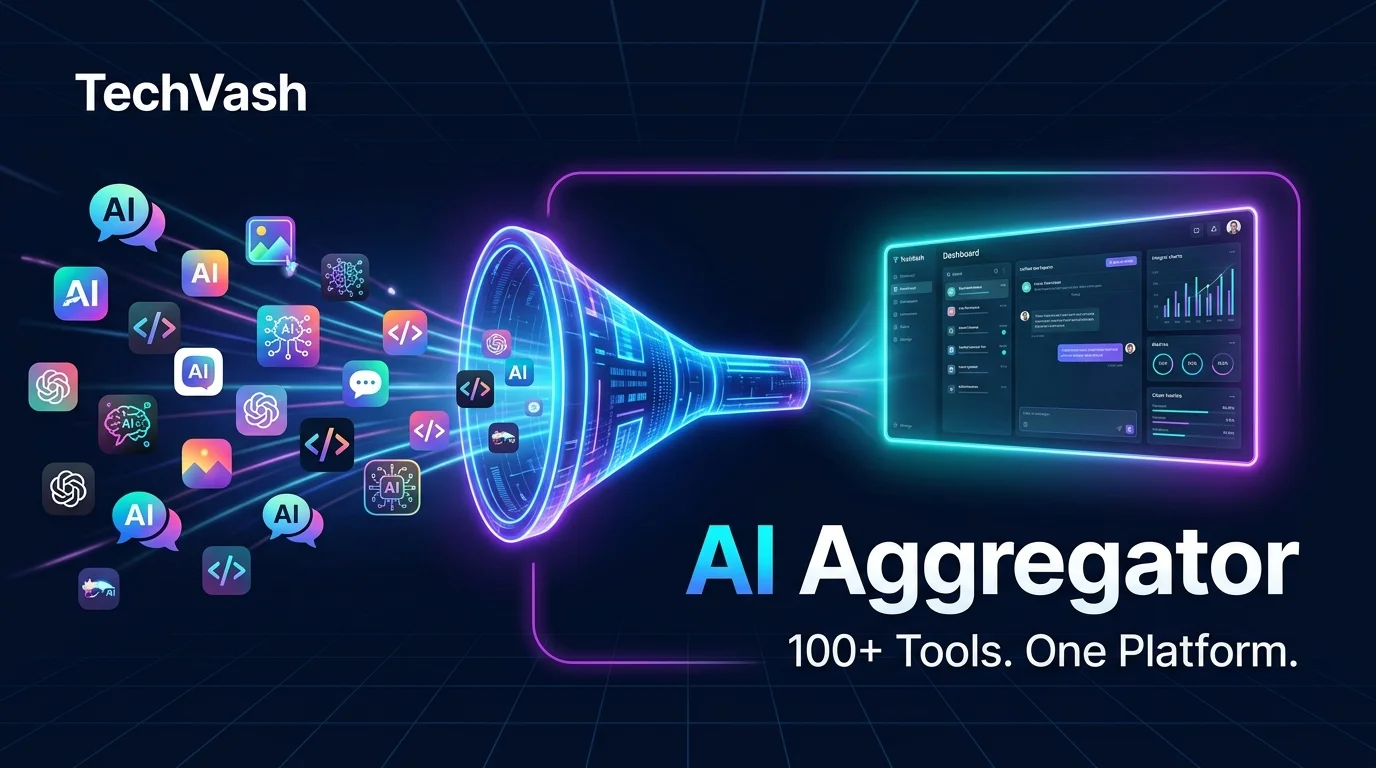
An AI aggregator solves this by bringing multiple AI models and tools into one platform, letting you write, research, create images, code, and more without juggling separate services.
But does access to 100+ AI tools actually save you time and money? In this guide, we’ll explain what an AI aggregator is, how it works, the types available in 2026, and whether it’s worth using.
What Is AI Aggregator Really?
An AI aggregator is a single platform that gives you access to multiple AI tools, models, or services from one place, usually through one login and one subscription.
Think of it like Netflix. Before streaming, you bought individual DVDs. Now, one subscription gives you thousands of movies. An AI aggregator does the same thing, but for AI tools. Instead of paying OpenAI, Anthropic, Google, and Midjourney separately, you pay one platform that connects you to all of them.
That’s it. That’s the core idea.
The reason this concept is exploding in 2026 is simple: the AI tool market has grown beyond anything we’ve seen before. There’s An AI For That, one of the largest tracking directories, now indexes over 52,000 AI tools as of mid-2026. Other directories like Toolradar track over 10,000 live products.
Depending on how you count and what inclusion criteria you use, the number ranges anywhere from 10,000 to 50,000+ active AI tools globally. In 2023, that number was around 1,000. The growth is staggering, and no single human can keep up with it.
An aggregator acts as your filter, your gateway, and your billing department, all rolled into one.
The Real Problem: Why You’re Drowning in AI Tools Right Now
Before we go deeper into how aggregators work, let’s name the actual pain you’re feeling. Because if you don’t understand the problem, the solution won’t make sense.
Your Subscriptions Are Stacking Up
The average American knowledge worker in 2026 juggles between 6 and 10 separate AI subscriptions.
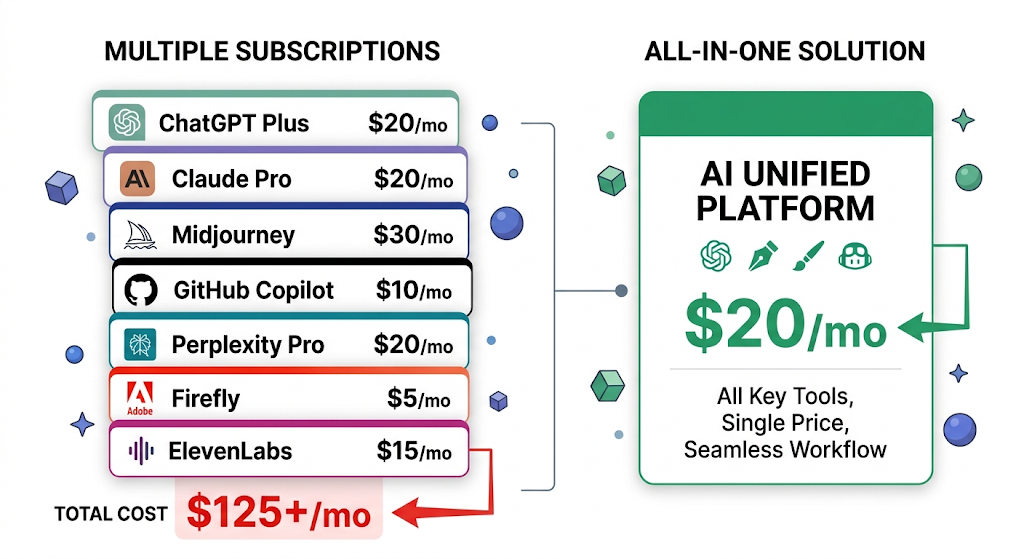
Here’s what a typical stack looks like in real dollars:
Tool
Monthly Cost (Approximate)
ChatGPT Plus
~$20
Claude Pro
~$20
Midjourney Standard
~$30
Perplexity Pro
~$20
Cursor Pro
~$20
ElevenLabs Starter
~$5–$22
Notion AI Add-on
~$10/user
Estimated Total
~$125–$140/month
That’s roughly $1,500–$1,700 a year for one person. If you run a small business with five employees using similar stacks, you’re looking at $7,500+ annually — before you even count the tools you forgot to cancel.
Note: Prices vary by plan tier, region, and promotional pricing. The figures above represent commonly reported U.S. pricing as of 2026, but always check each tool’s current pricing page for exact numbers.
You’re Context-Switching Yourself to Death
Every time you switch from ChatGPT to Claude to Midjourney, your brain resets. You re-enter your prompt style, re-upload your files, re-explain your project context. Research from the American Psychological Association consistently shows that task-switching can reduce productivity by up to 40%. Now imagine doing that with AI tools dozens of times a day.
You Can’t Tell Which Tool Is Actually Good Anymore
Dozens of new AI tools appear daily across launch platforms like Product Hunt and major directories. In fact, tracking data from Toolradar shows that 89% of its entire catalog was added in 2026 alone, which tells you just how fast this market is moving. Most new launches are thin wrappers around the same handful of large language models. But you don’t know that until you’ve already signed up, entered your credit card, and spent an hour figuring out the interface.
This is the fragmentation problem. And it’s getting worse every quarter.
How Does an AI Aggregator Actually Work?
Here’s where most articles get confusing. Let me keep it dead simple.
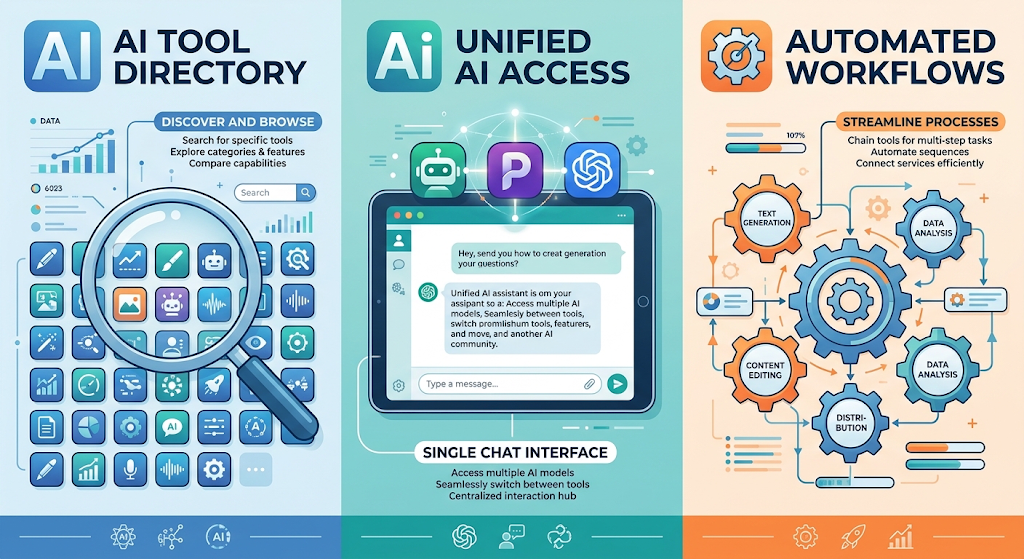
An AI aggregator works through one of three mechanisms. Most platforms combine two or all three.
Mechanism 1: The Curated Directory
This is the simplest type. The aggregator builds a searchable catalog of AI tools, organizes them by category (writing, image generation, coding, video, etc.), and adds user reviews and ratings. You browse, discover, and click through to the actual tool’s website.
You don’t use the tools inside the aggregator. It’s more like a phone book than a phone.
Examples in 2026 include There’s An AI For That (52,000+ tools indexed), Futurepedia, and Toolify.ai. These platforms update daily and serve as the starting point for most people’s AI tool discovery.
Mechanism 2: Unified Model Access
This is where it gets powerful. The aggregator signs backend agreements (API contracts) with multiple AI companies — OpenAI, Anthropic, Google, Meta, Mistral, and others. Then it gives you one chat interface where you can switch between all those models instantly.
You type a prompt. You pick which model answers. You compare outputs side by side. One login. One bill.
Poe (built by Quora) is the most popular consumer example in 2026, offering its full-access plan at $19.99/month (or $199.99/year). Poe uses a points-based compute system, meaning you get a generous monthly allocation of points to spend across models, but heavier models like GPT-4o and Claude 4 consume more points per message. Cheaper tiers starting around $4.99/month exist with more limited model access.
TypingMind takes a different approach entirely. Instead of a monthly subscription, it’s a one-time purchase (ranging from $39 for Standard to $99 for Premium) that gives you a polished multi-model chat interface where you plug in your own API keys from OpenAI, Anthropic, Google, etc. You pay for the UI once, then pay each AI provider directly for usage. It’s a great option if you want aggregator-style convenience without handing your data to a middleman.
Mechanism 3: Workflow Automation
This type goes beyond chat. The aggregator connects multiple AI tools into automated chains. For example: an incoming email triggers an AI summarizer, which feeds into an AI draft writer, which pushes the final draft to your CRM — all without you clicking anything.
Zapier’s AI Actions, Make.com, and n8n are the leaders here in 2026. They don’t just aggregate AI tools — they orchestrate them. Pricing varies by usage: Zapier bills per task, Make bills per operation (credit), and n8n bills per workflow run with a self-hosted option available. For small businesses, expect to pay $20–$50/month, though heavy AI workflows on Zapier can exceed that quickly.
AI Aggregator vs. AI Wrapper vs. AI Directory vs. AI Marketplace
This is the section every other article skips, and it’s the reason most people are confused about this space. These four terms get thrown around like they mean the same thing. They don’t.
An AI wrapper takes ONE existing AI model (usually GPT-4o or Claude) and puts a pretty interface around it with a few extra features. It doesn’t aggregate anything. It’s a single-tool skin. Think of tools like Jasper or Copy.ai in their early days — they were wrappers around GPT-3.
An AI directory lists AI tools so you can discover them. It doesn’t give you access to the tools. It’s a catalog. Futurepedia is a directory.
An AI marketplace lets developers buy, sell, or deploy AI models and tools. Hugging Face and the AWS Marketplace are examples. It’s transactional — you’re acquiring tools, not accessing them through a unified layer.
An AI aggregator gives you actual, functional access to multiple AI tools or models through a single platform. Poe, OpenRouter, and enterprise suites like AWS Bedrock fall here.
Here’s a quick way to remember the difference:
Wrapper = one tool, new outfit
Directory = a menu, no food
Marketplace = a store where you buy tools
Aggregator = an all-you-can-eat buffet
If you’re paying for multiple AI subscriptions and want to consolidate, you want an aggregator. Not a directory. Not a wrapper.
The 5 Types of AI Aggregators Available in 2026
Not all aggregators serve the same purpose. The right one for you depends entirely on who you are and what you need. Here’s the breakdown.
1. Consumer Chat Aggregators
These give you one chat window to talk to multiple AI models. You can ask GPT-4o a question, then immediately ask Claude 4 the same question, and compare the answers side by side.
Top picks in 2026: Poe, ChatHub, TypingMind (bring-your-own-keys model).
Best for: Individuals, writers, researchers, and anyone who uses AI chat daily and wants to compare model outputs without switching tabs.
Typical cost: $10–$20/month for subscription-based options like Poe. One-time purchase ($39–$99) plus API usage costs for self-hosted options like TypingMind.
2. API Aggregators (For Developers)
These provide a single API endpoint that routes your code’s requests to hundreds of AI models across dozens of providers. Instead of writing separate integrations for OpenAI, Anthropic, and Google, you write one integration and swap models with a single line of code.
Top picks in 2026: OpenRouter, LiteLLM, Portkey, Martian.
Best for: Software developers, AI engineers, and startups building AI-powered products.
Typical cost: Usage-based, not subscription-based. OpenRouter, for example, charges pass-through provider rates with no markup on inference — you pay exactly what the underlying model costs. They add a small fee (around 5–5.5%) when you purchase credits, and many models offer free tiers. OpenRouter currently supports 500+ models across 80+ providers. LiteLLM and Portkey function more as gateway/proxy layers and can be self-hosted for free or licensed for enterprise use. Actual savings compared to going direct depend on your model mix and volume — there’s no guaranteed percentage discount across the board.
3. Workflow Aggregators (No-Code Automation)
These connect AI tools into automated pipelines. You don’t need to code. You drag, drop, and set triggers. When X happens, AI tool Y does Z.
Top picks in 2026: Zapier AI Actions, Make.com AI modules, n8n, Flowise.
Best for: Marketing teams, operations managers, and small business owners who want AI to run in the background without manual input.
Typical cost: $20–$50/month for small-business usage, though complex AI-heavy workflows can push costs higher, especially on per-task billing platforms like Zapier.
4. Enterprise AI Suites
These are company-wide platforms that manage AI access, enforce security policies, track usage, and handle compliance. They’re not just aggregating tools — they’re governing them.
Top picks in 2026: Microsoft Copilot ecosystem (including Copilot Studio and Azure AI Foundry), Google Workspace AI / Vertex AI (now evolving into the Gemini Enterprise Agent Platform), AWS Bedrock (including Bedrock AgentCore), and Salesforce Einstein / Agentforce.
Best for: Companies with 50+ employees where IT needs to control which AI tools staff can use and how data flows.
Typical cost: Roughly $30–$60 per user per month as a ballpark figure, though actual pricing varies widely by vendor, edition, and negotiated enterprise contracts.
5. Niche Vertical Aggregators
These focus on a single industry. Instead of giving you access to every AI tool, they curate the best AI tools for one specific field — healthcare, legal, real estate, education, etc.
Emerging examples in 2026: Harvey (legal AI), Hippocratic AI (healthcare), Khanmigo (education).
Best for: Professionals in regulated industries who need AI tools that comply with industry-specific rules like HIPAA or attorney-client privilege.
7 Real Benefits of Switching to an AI Aggregator
Let’s move past theory. Here’s what actually changes in your day-to-day life when you consolidate.
1. You Stop Bleeding Money on Overlapping Subscriptions
Remember that $125+/month stack from earlier? A consumer chat aggregator like Poe gives you access to GPT-4o, Claude 4, Gemini 2.5, Llama 4, and Mistral for roughly $20/month on its full-access plan. That’s potentially a $100+/month savings — over $1,200 per year — for one person.
The math gets even more dramatic for teams.
2. You Kill the Tab-Switching Tax
One interface means your project context stays in one place. Your conversation history, your uploaded documents, your custom instructions — all centralized. You stop re-explaining yourself to five different AI tools every morning.
3. You Discover Tools You’d Never Find on Your Own
Quality aggregators surface niche tools based on your usage patterns. You might discover a specialized AI tool for legal contract review or architectural rendering that you never knew existed — simply because the aggregator recommended it.
4. Your Billing Becomes Predictable
One invoice. One renewal date. One line item on your expense report. No more surprise charges from a tool you signed up for in March and forgot about by July.
5. You Can Compare Model Outputs in Real Time
This is a game-changer for quality-sensitive work. Ask the same question to three models simultaneously. See which one gives you the best answer. Stop guessing which AI is “smarter” for your specific task — just test it in seconds.
6. Team Onboarding Gets Dramatically Faster
Training a new employee on 12 separate AI tools takes weeks. Training them on one aggregator takes an afternoon. The learning curve flattens because the interface is consistent regardless of which underlying model they’re using.
7. You’re Protected Against AI Tool Churn
Here’s something nobody talks about: AI startups fail at an alarming rate. Hundreds of AI startups have shut down or been acquired over the past couple of years, and the pace shows no signs of slowing. When a tool you rely on disappears overnight, your workflow breaks.
With an aggregator, the platform absorbs that shock. If one underlying model or tool goes away, the aggregator replaces it with an equivalent. Your workflow keeps running. You don’t scramble to find alternatives at 2 AM.
The Risks Nobody Warns You About
I’d be doing you a disservice if I only talked about the upside. Aggregators have real downsides, and you should know them before you commit.
Your Data Passes Through a Middleman
When you use ChatGPT directly, your prompt goes to OpenAI. When you use ChatGPT through an aggregator, your prompt goes to the aggregator’s servers first, then gets forwarded to OpenAI. That’s an extra hop. An extra place where your data exists.
Most reputable aggregators state clearly in their privacy policies that they don’t store or train on your prompts. But you need to actually read those policies. This extra data hop has real implications for businesses handling sensitive customer information, especially given the evolving U.S. regulatory landscape we’ll cover shortly.
Note: If you use a bring-your-own-keys option like TypingMind, this middleman problem is largely eliminated because your API calls go directly from your browser to the AI provider.
You Lose Access to Advanced Native Features
Aggregators typically support the core functionality of each AI model — text generation, basic image creation, code completion. But the advanced features that make individual tools special often don’t transfer.
For example, ChatGPT’s Canvas editing mode, Claude’s Projects workspace, and Midjourney’s style reference system are all native features that most aggregators can’t replicate. If you rely heavily on those specific capabilities, an aggregator might feel like a downgrade.
Usage Caps Are Often Hidden
That “$20/month for AI access” headline usually comes with an asterisk. Poe, for instance, uses a points system where heavier models consume more points per message. You might get generous access to smaller models like Llama 4 or Mistral but find yourself rationing your GPT-4o and Claude 4 usage by the end of the month. Read the fine print before you cancel your direct subscriptions.
No Single Aggregator Covers Everything
As of 2026, no aggregator on the market gives you access to every AI tool. Specialized tools like Runway (video generation), ElevenLabs (voice cloning), and Suno (music creation) often operate outside aggregator ecosystems because their APIs are proprietary or their compute costs are too high to bundle.
You’ll likely still need 1–2 standalone subscriptions for your most specialized tasks.
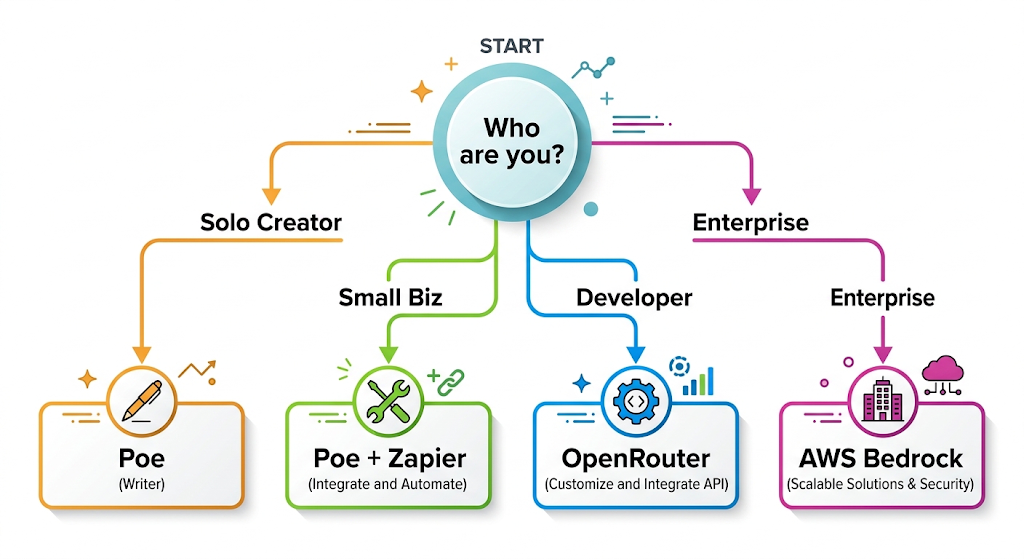
How to Choose the Right AI Aggregator (Based on Who You Are)
Stop reading generic “top 10” lists. Your choice depends on your specific situation.
If you’re a solo creator, freelancer, or student:
Go with a consumer chat aggregator like Poe for the simplest all-in-one experience at ~$20/month. If you’re more technical and want to avoid the middleman, TypingMind ($39–$99 one-time) lets you bring your own API keys and pay providers directly. Your goal is cost savings and convenience.
If you’re a small business owner with 2–20 employees:
Layer a chat aggregator on top of a workflow aggregator. Use Poe for daily AI tasks and Zapier AI Actions or Make.com to automate repetitive processes like email responses, social media drafting, and customer support triage. Your goal is reducing both cost and manual labor.
If you’re a developer or technical team:
Go straight to an API aggregator like OpenRouter. You don’t need a chat interface — you need a reliable, low-latency API that lets you swap models in your codebase without rewriting integrations. With 500+ models available and pass-through pricing with no inference markup, you pay only for what you use.
If you’re an enterprise with 50+ employees:
You need governance, not just access. Look at AWS Bedrock, Microsoft Copilot Studio, or Google Vertex AI. These platforms offer SSO integration, data residency controls, audit logs, and compliance certifications (SOC 2, HIPAA, FedRAMP) that consumer aggregators simply don’t provide.
The Future: AI Agents Are the Next Evolution of Aggregation
The aggregator model we’ve described — where you pick the tool and you switch between models — is already evolving. The next phase is AI agents that aggregate autonomously.
In 2026, agentic systems like OpenAI’s Operator, Anthropic’s Computer Use, and Google’s Project Mariner can independently decide which AI tool or model to use for each sub-task without asking you. You give the agent a goal (“research competitors and draft a strategy document”), and it autonomously selects a search AI, a data analysis AI, and a writing AI — orchestrating them behind the scenes.
This shifts the aggregator concept from manual consolidation to intelligent orchestration. You won’t choose tools anymore. Your AI agent will.
The platforms that win the next three years won’t be the ones with the biggest tool catalogs. They’ll be the ones with the smartest routing logic — the ones that automatically match each task to the best available AI without human intervention. Enterprise agent platforms from Microsoft, Google, AWS, and Salesforce are already racing to build this capability into their suites.
Regulatory Landscape: What U.S. Users Need to Know in 2026
If you’re using AI aggregators for business purposes in the United States, the legal landscape has shifted significantly — and it’s more nuanced than most tech articles suggest.
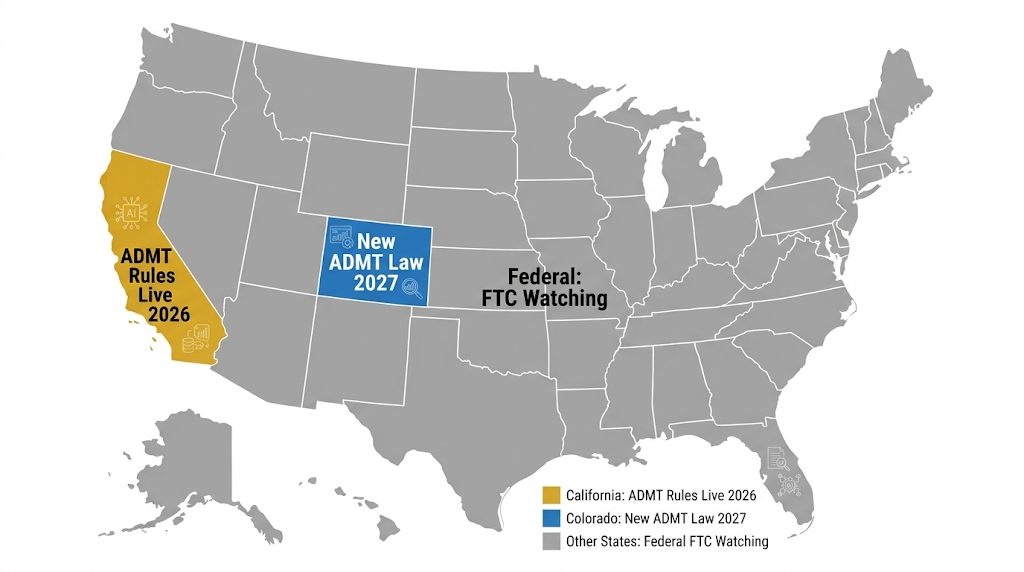
At the federal level, the U.S. doesn’t yet have a comprehensive AI law equivalent to the EU AI Act. However, the FTC has increased enforcement around AI transparency, particularly targeting platforms that misrepresent which models are powering their outputs or how user data is handled.
At the state level, two developments matter most:
California — The California Privacy Protection Agency (CPPA) adopted regulations on Automated Decisionmaking Technology (ADMT), cybersecurity audits, and risk assessments in late 2025, with key provisions becoming operative January 1, 2026. These rules apply to businesses using ADMT for “significant decisions” — including financial, lending, hiring, and healthcare contexts — and require notices to consumers, opt-out rights, risk assessments, and periodic audits. Importantly, the final ADMT regulations removed express references to artificial intelligence as a defined term, meaning the rules capture AI systems through the broader ADMT framework rather than a standalone AI category. If your aggregator processes California residents’ data in ways that feed into consequential automated decisions, these obligations likely apply to you.
Colorado — The original Colorado AI Act (SB 24-205), signed in May 2024, was initially set to take effect February 1, 2026. However, it was repealed and replaced by SB 26-189 in May 2026 before it ever went into force. The new framework shifts focus toward Automated Decisionmaking Technology (ADMT) used in consequential decisions, with substantive requirements taking effect January 1, 2027 — not February 2026 as originally planned. If you operate in Colorado or serve Colorado residents, the new ADMT-focused regime is what you need to prepare for.
Frequently Asked Questions About AI Aggregator
What is the best AI aggregator in 2026?
For most individual users, Poe offers the best balance of model variety, price (~$19.99/month for full access), and ease of use. For developers, OpenRouter is the top API aggregator with 500+ models and no inference markup. For enterprises, AWS Bedrock leads in compliance and governance. The “best” depends entirely on your use case.
Are AI aggregators free?
Most offer a free tier with limited access to smaller models like Llama, Mistral, or Gemma. Premium tiers that include GPT-4o, Claude 4, and other frontier models typically cost $10–$50/month. Poe, for example, has lower-cost tiers starting around $4.99/month with reduced model access. The free tiers are useful for testing but not sufficient for daily professional use.
Is it safe to use AI tools through an aggregator?
Generally yes, provided you choose a reputable platform with a clear privacy policy. Reputable aggregators do not store your prompts or use them for model training. However, your data does pass through the aggregator’s servers before reaching the AI model, which adds a layer of risk. If data privacy is your top concern, consider a bring-your-own-keys option like TypingMind, where API calls go directly to the provider.
Can I cancel my individual AI subscriptions after switching to an aggregator?
In most cases, yes — but test the aggregator thoroughly first. Make sure it supports the specific features you rely on (like ChatGPT’s Canvas or Claude’s Projects) before canceling. Many users keep one direct subscription for their most-used tool and aggregate the rest.
How is an AI aggregator different from an AI wrapper?
A wrapper sits on top of a single AI model and adds a custom interface. An aggregator connects you to multiple AI tools and models through one platform. Wrappers narrow your options. Aggregators expand them.
Do AI aggregators work with custom or private AI models?
Enterprise-grade aggregators like AWS Bedrock and Azure AI Foundry support custom model deployment alongside public models.
Consumer aggregators like Poe typically only support publicly available models, though TypingMind allows you to plug in your own API keys for any model you have access to — including private or fine-tuned endpoints.
Final Thoughts on Aggregators
If you’re using three or more AI tools regularly, an aggregator will save you money, reduce your mental overhead, and protect you from the chaos of a market that now exceeds 50,000 tracked products and adds dozens of new tools every single day.
Start with a consumer chat aggregator like Poe if you’re an individual. Layer in workflow automation if you run a team. Move to an enterprise suite if compliance matters to your industry. And keep an eye on the regulatory landscape, California’s ADMT rules are already live, and Colorado’s new framework kicks in January 2027.
The era of managing a dozen separate AI subscriptions is ending. The era of intelligent consolidation is here.